
Volatility is not new. The question is how to live well through it.
Automation, climate instability, and changing information environments are reshaping where we invest, what we value, and how we live and work together. These changes reach us first through our relationships, and relationships are what culture is made of.
Culture isn’t something we make from scratch. It’s something we receive and then use: stories, practices, skills, ways of arguing, ways of deciding together. Drawing on sociologist Ann Swidler: in settled times culture works quietly. In unsettled times people reach for it on purpose and test which practices still serve.
Variety in culture is what lets people adapt, the way a gene pool does. But the forces unsettling us are also narrowing that variety: the same tools everywhere, decisions automated, efficiency ahead of everything else. And with it comes a growing sense that the outcome is already decided.
It isn’t.
There are more options than that story allows, and most of them are already held in the cultures we belong to.
In the Meantime works with leaders of organizations, communities, and institutions to recover those practices, test what still holds, and keep them in working order for what comes next. We don’t offer calm, answers, or mastery.
We offer options, and time to think.
Approaches developed in response to past crises are forgotten. When the hurricane arrives or the next pandemic is discovered, we have fewer options to draw upon in response.
Jerrold McGrath, In Praise of Disorder (2023)
What we do
Not everything needs to change. Some of what an organization has is working, and the next disruption can wear it away without anyone having decided it should go. We help protect and maintain it.
Where something does need to adapt, we agitate, not at the level of policy but underneath it, in how people actually decide, trust, and work together.
We work with organizations, communities, and institutions through workshops, leadership development, and facilitated processes that produce strategies, guidelines, and policies. In each, we bring forward old and new practices, put them to work on the situation in front of you, and leave you with approaches you can repeat without us.
A policy can be written, or rewritten, without anything changing. Work underneath it and difficult conversations get easier, decisions are made by the people who will carry them out, and the policy that follows has something to stand on.
Who we are
Bianca Wylie is a facilitator, advisor, and writer. She’s an accomplished public interest technology advocate whose work has been profiled in Le Monde and The Washington Post. Bianca has a background in software development, professional facilitation, and digital governance. She is a frequent speaker and guest lecturer, and her writing on technology has been published in a range of publications including the Boston Review, VICE, The Globe and Mail, and Toronto Life.
Jerrold McGrath has 20 years’ experience designing programs and encounters that help people find somewhere to stand when the footing is uncertain. This includes international residencies, festivals, national consultations, leadership programs, and multi-day encounters that place people inside artificial intelligence, ecological damage, and political uncertainty rather than in front of descriptions of them. He is a former Program Director at the Banff Centre and former Executive Director at the Japanese Canadian Cultural Centre.
Events
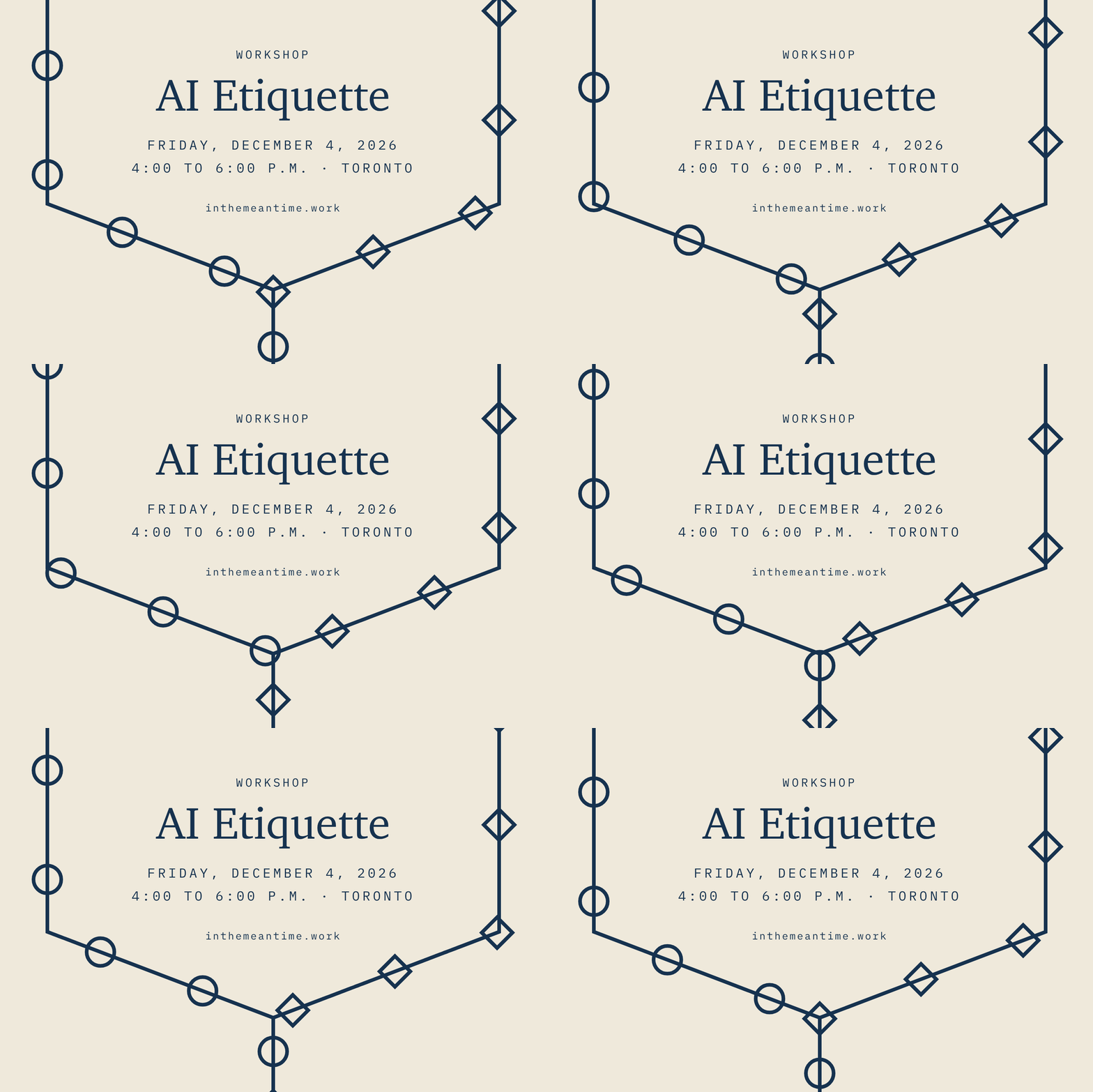
Our workshops are intimate and in person. Each one centres on a practice: some long established, some reworked for present conditions, some still taking shape. We put it to work on the situations participants bring, drawing on what the people in the room already know. You leave with something you can run again, and a next step to take back.
Join one of our upcoming workshops.
We also design custom workshops and programs for organizations and teams.
Writing
Strategy
We build strategy with the people who will carry it out, not around them.
Together we:
look at where things are going and what that means for your customers, your communities, and your staff
name the assumptions your organization is running on, including the ones nobody has said aloud
test those assumptions with your people through small, designed experiments
make the decisions in the room, and write down what was decided and why
develop an approach for implementation and maintenance of the decisions
Then we come back, on a date set at the start, to see what held.
Organizations that stop for long enough to be intentional rather than reactive about the adoption of new technologies can help protect those parts of their culture that require the most care and attention.
Bianca Wylie
Leadership Development
Our leadership programs run as half-day, full-day, and multi-day sessions on leading when conditions won’t settle. Technology and climate are where most of that pressure shows up right now, so they are where much of our work starts.
The programs are experiential. Leaders work on the situations they are actually facing, alongside people from other sectors and disciplines facing versions of the same thing.
Some sessions bring leaders together from different sectors. Others are designed with a single organization or field, around the decisions in front of it: becoming a more deliberate buyer of new technology, or setting up the routines that keep a new system working, and accountable, after launch. The technology material draws on Bianca Wylie’s work in technology policy and digital governance.
For centuries, beating the bounds has been a community’s answer to boundaries being moved without anyone announcing it. This half-day workshop runs that procedure with sixteen people, on the boundaries of their own work.